Grasbrook's heating and cooling network: who will build it, and when
The supplier for the new Grasbrook development has been chosen: the city-owned HafenCity Hamburg GmbH has selected enercity Contracting Nord GmbH to build and operate its heating and cooling supply. The contract, described as a service concession, was awarded following a Europe-wide procurement process. The project partners announced the decision on 15 October 2026. The first heat deliveries are planned for 2031. HafenCity Hamburg GmbH · enercity
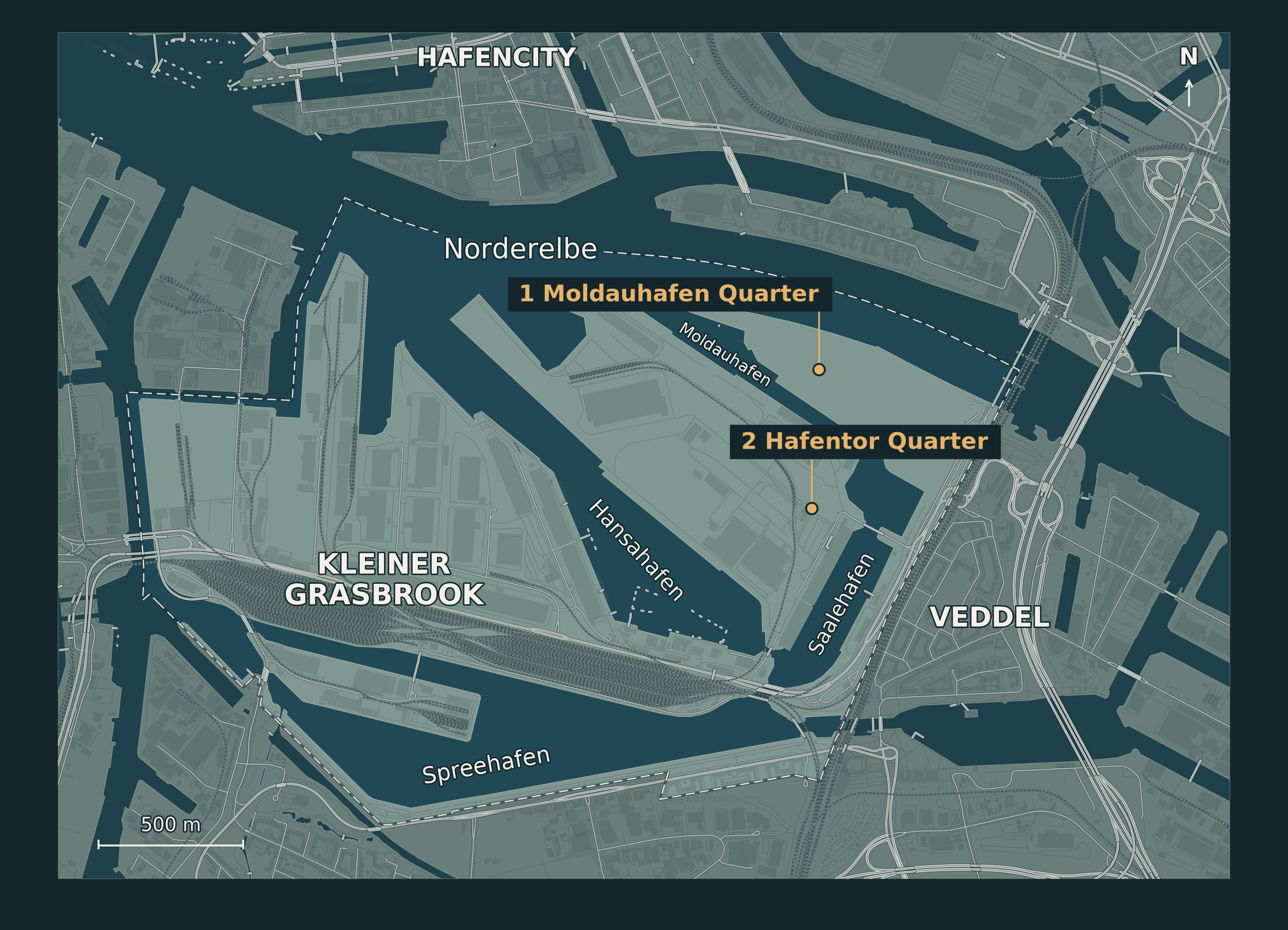
1 and 2 indicate the approximate areas of Moldauhafen Quarter and Hafentor Quarter. Gold lines only link labels to markers. The dashed line is the administrative district boundary, not a quarter or network boundary. Energy facilities and pipelines are not shown.
Two quarters, two start dates
Moldauhafen Quarter (1) occupies the peninsula between the Norderelbe and the Moldauhafen basin. It is planned primarily for housing. Hafentor Quarter (2) adjoins it to the south of Moldauhafen and includes areas on both sides of Saalehafen. It is intended for commercial uses. Urban development concept
Heating is planned to start in Moldauhafen in 2031. Heating and additional cooling are planned for Hafentor from 2035. According to enercity, the concept reflects different needs: heating is the main requirement in the residential quarter, while the commercial quarter will also need more energy for cooling. enercity
The plans provide for approximately 7.3 kilometres of heating pipes in total and 1.8 kilometres of cooling pipes in Hafentor. Infrastructure is to expand alongside the development. These dates and pipe lengths describe the plans, not infrastructure already completed or completion dates for individual buildings. enercity · Solarserver
Where the heat is to come from
At launch, Grasbrook is to connect to an existing district heating network in Hamburg. enercity already uses it to serve eastern HafenCity and Rothenburgsort. An important source is industrial waste heat from the Aurubis works: heat produced during manufacturing that can be put to use in other buildings. The connection is intended to provide heat before all of Grasbrook’s own generating facilities have been built. HafenCity Hamburg GmbH · enercity
Additional facilities are to follow both within and outside the new district. The plans include heat pumps using heat from the air and, potentially, wastewater. Biomethane is intended to cover peak demand. enercity
What “more than 90 per cent” means
At the start of supply, renewable energy and unavoidable waste heat combined are intended to provide more than 90 per cent of the heat. The figure explicitly covers both categories together, not renewable energy alone. The target is to increase their combined share to 100 per cent by 2040. These are announced goals for the future supply, not present-day measurements from an operating Grasbrook network. HafenCity Hamburg GmbH · enercity
What this means for buildings and neighbours
According to enercity, the shared network is intended to reduce the need for separate heating and cooling equipment in individual buildings and thus the space it occupies. The reviewed announcements do not yet specify future customer prices, individual connection terms or precise locations for new facilities and pipelines. enercity
For neighbouring Veddel, enercity has announced a network extension from early 2027. This separate phase should not be confused with the planned 2031 start of supply in Grasbrook. enercity
More on the development of the two quarters: Visitor parking in Moldauhafen Quarter and O’Swaldkai access road and Hafentor Quarter.
Sources checked: 19 October 2026. The project partners’ announcements date from 15 October. According to Energie & Management’s report of 16 October, the award decision was made on 22 June and the contract was signed on 1 October. The full concession contract was not examined for this article.
Map credits: Cartography: ChatGPT for kleiner-grasbrook.net, 19 October 2026, R3. Roads, railways, buildings and water: © OpenStreetMap contributors, ODbL 1.0; Geofabrik Hamburg extract, data dated 15 October 2026, 20:21 UTC according to the provenance file. Administrative boundary: Free and Hanseatic City of Hamburg, State Agency for Geoinformation and Surveying (LGV), ALKIS administrative boundaries, district 117, Data Licence Germany – Attribution 2.0; unchanged stored geometry, no verified survey date. Adaptations: crop, Nachtatlas styling, preserved polygon holes and outside dimming, water labels with bank clearance and approximate quarter-area indications based on the urban development concept. Data-based orientation, not an official development or energy-network map.
OpenStreetMap · ODbL 1.0 · Geofabrik Hamburg · LGV administrative boundaries · LGV licence · OSM data extract used (GeoPackage)